Category: Sin categoría

In Observance of World Marrow Donor Day: Honoring the People Who Carry Our Donors’ Legacy Forward

Every September, the World Marrow Donor Association (WMDA) marks World Marrow Donor Day, a global day to say #ThankYouDonor to the millions of people who register, donate, and give patients a second chance at life through stem cell and bone marrow donation. This year’s observance falls on September 22, and Ossium Health is proud to participate as a Bronze Partner.

Most World Marrow Donor Day tributes go directly to donors. Their generosity is the reason this day exists.

At Ossium, our path to honoring donors looks a little different. The donors who make our work possible are deceased organ donors whose bone marrow gifts can become a source of life-saving cell therapies. While we cannot thank these donors ourselves, we can honor their generosity, remember the lives behind every donation, and recognize the people who help carry their legacy forward.

Today, in observance of World Marrow Donor Day, we want to recognize our recovery partners.

Ossium’s recovery partners include organ procurement organizations and recovery professionals across the country who care for donors and donor families during some of life’s most difficult moments. They approach families with compassion, help communicate what donation means and what it can make possible, coordinate the donation process, and provide support and aftercare that extends far beyond recovery.

Their work creates the bridge between a family’s decision to donate and the patients who may one day receive a transplant made possible by that gift.

In the spirit of WMDA’s Hope Heroes campaign, we believe these partners deserve recognition as well. Hope Heroes can be found throughout the journey to transplantation, from the people who support donors and families to those who coordinate care and ultimately help bring a stem cell therapy to a patient in need. Our recovery partners play an essential role at the very beginning of that journey by caring for the donors and families who make it all possible.

We are grateful for every organ procurement organization that partners with Ossium and entrusts us with the opportunity to extend a donor’s gift through bone marrow donation.

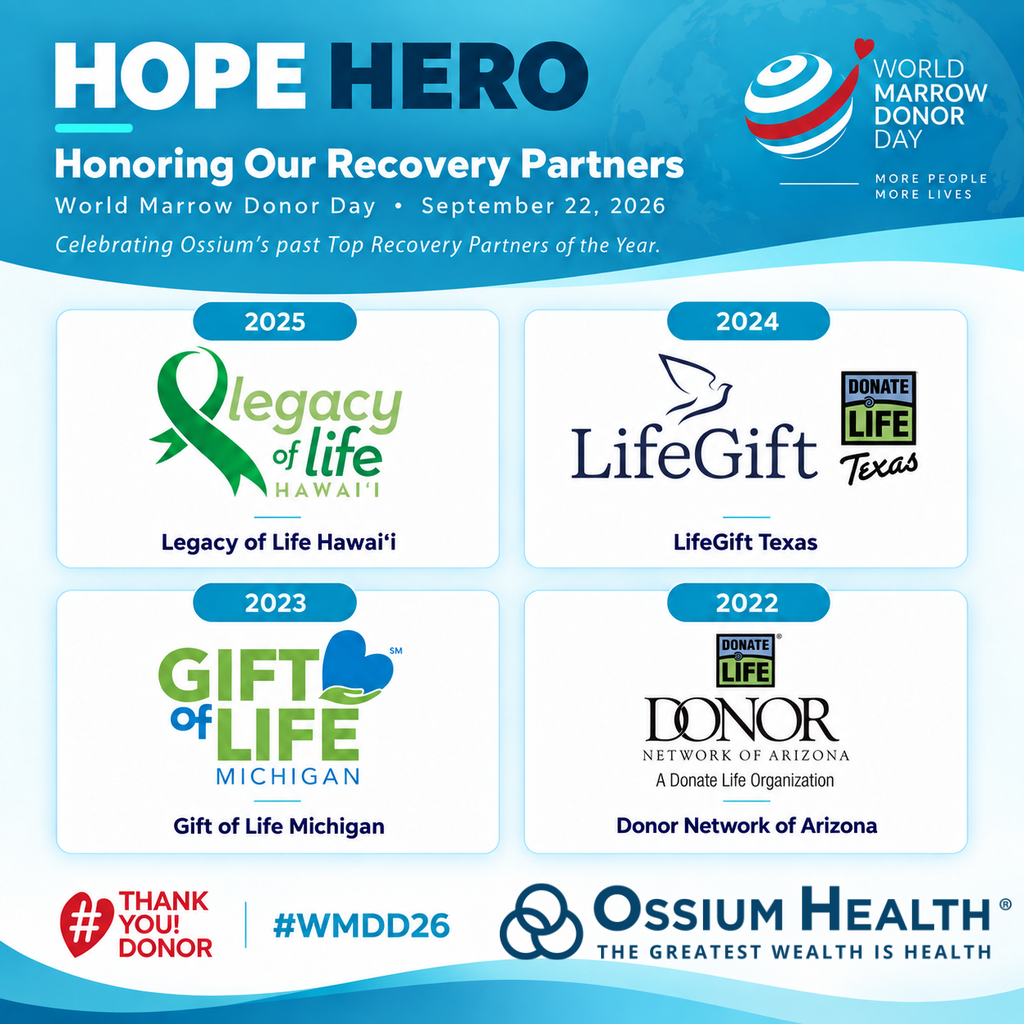
We also want to recognize our past Top Recovery Partners of the Year, whose teams have demonstrated an extraordinary commitment to Ossium’s mission and to honoring the gift of donation:

2025: Legacy of Life Hawai‘i

2024: LifeGift Texas

2023: Gift of Life Michigan

2022: Donor Network of Arizona

Each represents a different community, but all share something fundamental: a commitment to donors and donor families, and the possibility that one person’s gift can continue to create hope for others.

To every recovery partner working alongside Ossium, thank you.

Thank you for caring for donor families. Thank you for honoring the wishes and generosity of donors. Thank you for trusting us to help carry those gifts forward.

And most importantly, thank you for helping make it possible for someone else to receive a second chance at life.

Learn more about World Marrow Donor Day at worldmarrowdonorday.org.
First Pediatric Transplant with Ossium Bone Marrow

Physicians at Riley Children’s Health at Indiana University (IU) Health have performed the first pediatric bone marrow transplant using Ossium’s off-the-shelf bone marrow. This milestone extends a treatment approach that has shown encouraging results in adults and is a meaningful step in expanding donor options for children.

The 14-year-old patient was diagnosed with acute myeloid leukemia (AML) in August 2025. In January 2026, he received a first transplant using living donor stem cells, but the cells failed to engraft, meaning they did not establish themselves in his bone marrow and begin producing healthy blood cells. “When the first transplant failed and there were no remaining donor matches, we were facing a race against time,” said Dr. Jodi Skiles, medical director of Riley’s pediatric stem cell transplant program and associate professor of clinical pediatrics at Indiana University School of Medicine. Without a new donor quickly, the patient’s prognosis was grave.

Dr. Skiles turned to Ossium’s bank of cryopreserved bone marrow recovered from organ donors. The marrow is manufactured, cryopreserved, and held in a banked inventory, making it available for on-demand shipment within days rather than the months typically required to search for and secure a living unrelated donor graft. Ossium’s process yields more cells per donor than can be practically obtained from a living donor, allowing physicians to select an optimal cell dose. Together, immediate availability and high cell dose make the platform particularly relevant in urgent scenarios such as graft failure, donor attrition, and rapidly progressing disease.

“Because these stem cells are banked and ready to use, we were able to act in days instead of months,” Dr. Skiles said. “This treatment has the potential to dramatically expand access to transplant for children who previously had few or no remaining treatment options, giving us a way to close critical gaps in care and offer hope to families facing impossible circumstances.”

The patient received a transplant with organ donor bone marrow in March 2026 through Ossium’s HOPE Program. The cells engrafted within weeks, and the patient is now in remission.

“His story is a huge advancement for science,” Dr. Skiles said. “The fact that he survived and is thriving and got to be outpatient relatively quickly is shocking.”

Extending that capability to pediatric patients carries particular weight. For children with aggressive blood cancers, an off-the-shelf, ready-when-needed graft source offers a path to transplant that did not previously exist. Pediatric transplant cases have historically been among the most time-sensitive because pediatric disease often progresses fast, and a failed or delayed transplant can foreclose options within weeks. A graft that is characterized, banked, and ready to ship directly addresses that timeline.

The need extends well beyond leukemia. Each year, approximately 4,000 children in the US are diagnosed with blood diseases that could be successfully treated with an allogeneic bone marrow transplant, yet nearly half never receive one. In children, allogeneic transplant, which uses healthy blood-forming cells from a donor, is often the only curative option for a range of malignant diseases like acute lymphoblastic and myeloid leukemias, but also non-malignant conditions including sickle cell disease, transfusion-dependent thalassemia, severe aplastic anemia, inherited bone marrow failure syndromes such as Fanconi anemia, severe combined immunodeficiency and other primary immunodeficiencies, and certain inborn errors of metabolism. Transplant is curative for many of these diseases when a suitable donor can be found in time, yet donor access remains limited. Only about a quarter of patients have a matched sibling donor, and those who must rely on unrelated living donor registries face delays and uncertainty. A centralized bank with grafts available on demand adds donor options and removes the procurement delay that can be decisive for a young patient with rapidly progressing disease.

“Treating our first pediatric patient is a defining moment for Ossium,” said Kevin Caldwell, Ossium’s CEO, Co-Founder and President. “No child should run out of time waiting for a donor, and this milestone moves us closer to a world where none has to.”

This case also reinforces what the broader clinical experience has shown: organ donor bone marrow can engraft reliably and perform across a range of urgent and routine scenarios. This pediatric case was the 21st transplant performed with Ossium’s organ donor bone marrow, a total that has since grown to 28 patients, all of whom successfully engrafted. Treating the first pediatric patient turns possibility into precedent, laying the foundation for many more children to receive this life-saving therapy.

See more on this patient’s journey and what this advancement means for the field: